



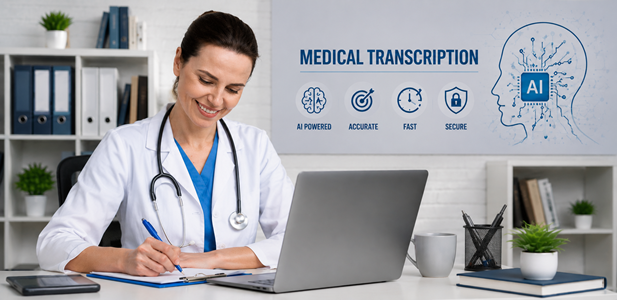


Healthcare providers manage large amounts of clinical information every day, making fast and accurate documentation essential. Medical Transcription is changing with the use of artificial intelligence (AI), speech recognition, and natural language processing. These technologies can convert dictated speech into written clinical documentation, helping reduce repetitive work and support more efficient workflows.

AI does not simply replace traditional transcription. When used with appropriate quality checks and human review, it can become a useful tool for improving the speed and consistency of medical documentation.
How AI Supports Medical Transcription
AI-powered transcription systems listen to spoken clinical information and convert it into text. Natural language processing can then help identify medical terms, organize information, and prepare content for clinical documentation.
The technology can support doctors, hospitals, clinics, and other healthcare organisations by reducing manual typing and speeding up routine documentation tasks.
A 2025 systematic review of 29 studies found that AI-based transcription showed potential to improve documentation efficiency and reduce the documentation burden, although performance varied significantly across clinical settings.
Key Benefits of AI in Medical Transcription
1. Faster Documentation
AI can convert dictation into text within seconds. This can reduce the time required to create clinical notes and help healthcare professionals complete documentation sooner.
Faster documentation may also support quicker access to patient information, particularly in busy practices and healthcare facilities.
2. Reduced Administrative Work
Documentation can take a significant amount of a physician's working day. A 2026 review noted that physicians may spend more than half of their workday on electronic health record tasks.
AI can handle repetitive transcription tasks, allowing healthcare professionals to spend less time typing and more time on clinical responsibilities.
3. Improved Workflow Efficiency
AI can help streamline the movement from dictation to a completed clinical note. It can also support structured templates and integrate with electronic health record systems when properly configured.
This can reduce unnecessary manual data entry and make documentation workflows more consistent.
4. Better Support for High Documentation Volumes
Hospitals and medical practices often handle large numbers of patient records. AI can assist with routine transcription tasks across different departments, helping teams manage documentation demands more efficiently.
5. Greater Focus on Patient Care
Reducing documentation workload can give physicians more opportunity to focus on patients and clinical decisions. In a 2024 AMA survey of nearly 1,200 physicians, 75% said AI could help improve work efficiency, while 54% believed it could help with stress and burnout.
AI Can Improve Efficiency, But Accuracy Still Matters
The benefits of AI should not be confused with complete automation. Medical documentation requires a high level of accuracy because errors can affect patient records and clinical communication.
A study of 217 clinical notes found an error rate of 7.4% in speech recognition generated documents. After professional medical transcriptionist review, the error rate fell to 0.4%, showing the value of human quality control.
More recent research also shows that AI transcription performance can vary based on speech patterns, clinical settings, accents, background noise, and specialized terminology. Human review therefore remains important for reliable clinical documentation.
The Best Approach Combines AI and Human Expertise
AI can manage repetitive transcription work, but trained professionals can review the output for medical terminology, context, formatting, and accuracy.
This combined approach can offer several advantages:
- Faster initial transcription
- Professional quality review
- Correction of medical terminology
- Better consistency in clinical documents
- Reduced administrative workload
- Greater confidence in the final record
For healthcare organisations, the goal should not be to choose between technology and people. The stronger approach is to use technology where it adds value while maintaining appropriate human oversight.
What Should Healthcare Providers Consider?
Before adopting an AI transcription solution, healthcare organisations should evaluate:
- Accuracy across different medical specialties
- HIPAA and patient data protection requirements
- Integration with existing EHR systems
- Support for medical terminology
- Human review and quality assurance processes
- Ease of use for physicians and staff
- Overall cost and workflow impact
Choosing the right solution requires more than looking at transcription speed. Accuracy, security, usability, and integration are equally important.
The Future of AI in Medical Documentation
AI will continue to play a larger role in clinical documentation. Future systems are expected to provide better speech recognition, improved understanding of medical language, smarter editing, and deeper EHR integration.
However, current evidence supports AI as an assistive technology rather than a replacement for professional review. The most effective approach is likely to combine automation with experienced human oversight.
For healthcare providers seeking reliable documentation, professional Medical Transcription Services can complement AI technology by providing the review and quality control needed for accurate clinical records.
Frequently Asked Questions
What is AI medical transcription?
AI medical transcription uses artificial intelligence and speech recognition technology to convert spoken clinical information into written medical documentation.
What are the main benefits of AI in medical transcription?
The main benefits include faster documentation, reduced administrative work, improved workflow efficiency, and support for high volumes of clinical documentation.
Can AI completely replace medical transcriptionists?
AI can automate many routine tasks, but it can still make errors with medical terms, accents, context, and complex speech. Human review remains important for accuracy.
Is AI medical transcription accurate?
Accuracy varies by system, specialty, speaker, and clinical environment. Professional review can help identify and correct errors before documentation is finalized.
Is AI medical transcription HIPAA compliant?
HIPAA compliance depends on how the AI solution is designed, configured, operated, and secured. Healthcare organizations should evaluate the provider's privacy and security practices before implementation.


